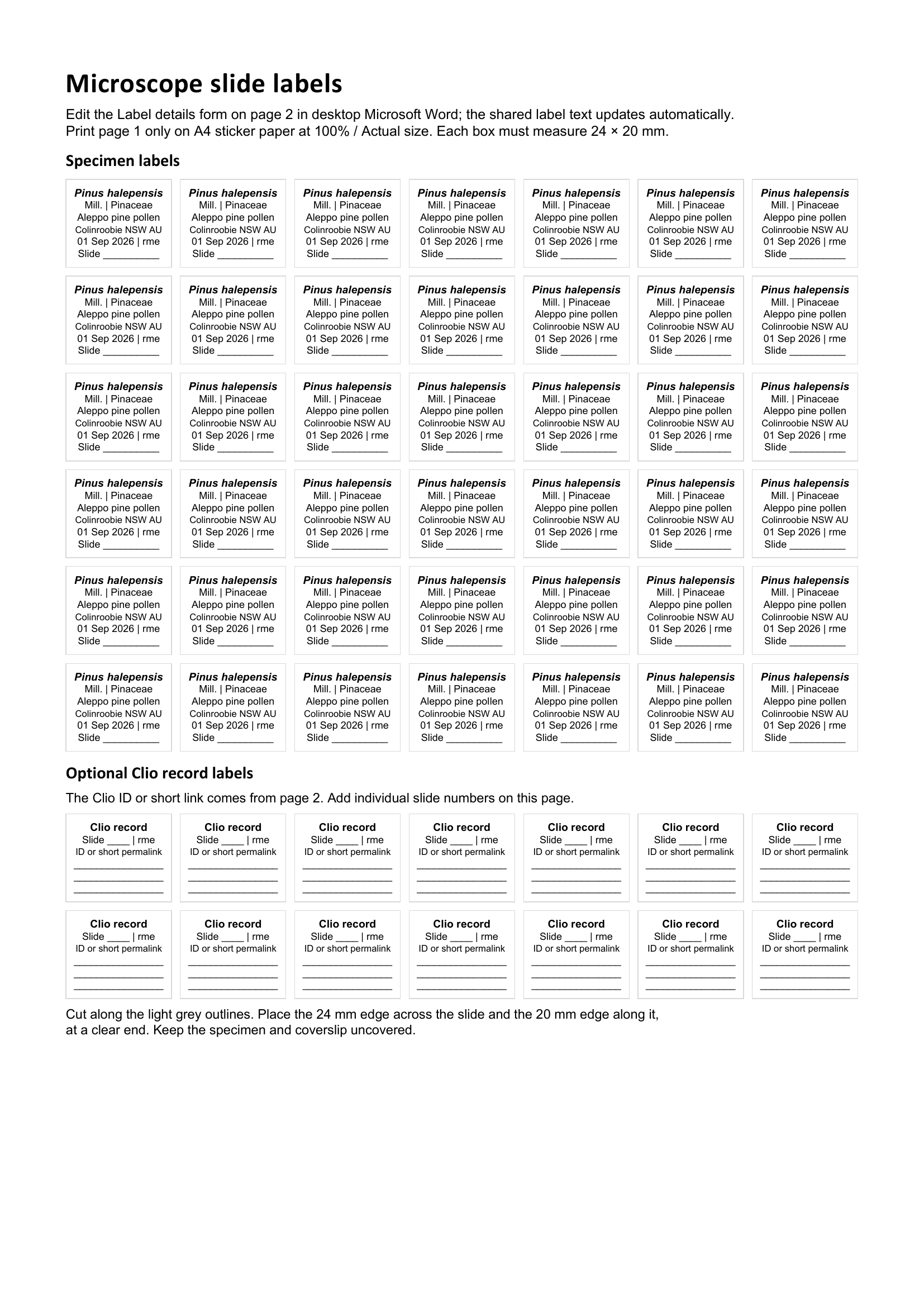
Fill in one form in desktop Word to update all 42 specimen labels.
The A4 sheet uses 24 × 20 mm labels and includes an editable Aleppo pine pollen example.
Word (.docx) · 47 KB · 2 pages · Linked fields · No macros
Print page 1 at 100% / Actual size on a full sheet of sticker paper.
Reference library
The reference entries below are maintained by other organisations. Clio does not host,
mirror, or vouch for them, and listing is not endorsement, partnership, or any claim of a
relationship with the maintainer. Each entry states who runs it, what it is good for, what
it cannot do, its reuse terms as the maintainer publishes them, and when it was last
checked.
How each entry was checked is shown on the entry. A research pass means
the entry was checked against the maintainer’s public pages on the stated date; it is
not continuous link monitoring. A curator review means a person has read the resource
and confirmed the entry against it. Those are different claims, so they are labelled
differently rather than blurred together.
No entry has been curator-reviewed yet: all 94 carry a dated research pass.
If an entry is wrong or a link has rotted,
tell us and it will
be corrected.
Nothing matches those filters.
An entry is only added once someone has checked it and written an honest limit for it.
Clear a filter, or
suggest a resource.
Division of Structural and Functional Botany, University of Vienna, supervised by AutPal
A palynological database in which an entry ideally carries a detailed grain description, LM, SEM and TEM images, images of the plant and flower, and the relevant literature.
Best for
Checking a description against a carefully written one for the same taxon, and seeing the same grain across several imaging modalities at once.
Limits
Coverage is entry-by-entry rather than comprehensive — roughly 4,650 species at last check — and not every taxon carries the full complement of description, images and literature. The electron-microscope images show detail you will not resolve on a light microscope, which makes them easy to over-read when matching your own view.
Coverage
Global, with strong European representation. Modern pollen and spores; roughly 4,650 species across 1,810 genera.
Reuse
Custom licence, not Creative Commons: educational and non-commercial use only, with the photographer and PalDat credited. Commercial use requires written permission.
Imaging
Light microscopy · Light microscopy, hydrated · Scanning electron microscopy · Transmission electron microscopy
Contributing
Free online access to read; a free registration is required to publish data.
In 2021 PalDat absorbed the PONET database, adding more than 2,000 datasets of high-resolution light micrographs of hydrated pollen. That hydrated-LM material is the closest published analogue to what you are actually seeing down the tube, and it is the part of PalDat to reach for first if you are matching against your own light-microscope view.
Division of Structural and Functional Botany, University of Vienna
PalDat's own curated set of links to other palynology sites, collections and projects.
Best for
Finding the regional atlas or specialist collection that no general list will have thought to include.
Limits
A link list maintained by a third party, with no stated review cadence. Expect dead links: at the last check it still listed the University of Arizona's pollen image catalogue, which returns a 404. Treat it as a set of leads to verify, not a vetted index.
Coverage
Global, weighted toward European institutions.
Reuse
Not stated by the maintainer.
Worth mining rather than duplicating. If you are looking for something this library does not yet list, start here before searching generally.
PalaeoWorks Laboratory, Department of Archaeology & Natural History, The Australian National University
Free online access to the largest pollen and spore collection in the Australasian region, with details on over 15,000 species, searchable or browsable by family.
Best for
Australasian material, where a European or North American atlas will simply not contain the taxon you are looking at.
Limits
Regional by design, and of limited use outside Australasia. The 15,000-species figure counts records with morphological and locality metadata — image coverage is considerably thinner, and it is normal to reach a fully described record that carries no photograph at all. Light microscopy only.
Coverage
Australasia. Over 15,000 species described. The physical collection is held at ANU in Canberra.
Reuse
CC BY-NC-SA 3.0, stated site-wide.
Imaging
Light microscopy
The site is explicitly built for amateurs as well as professionals, which makes it an unusually good starting point. For contributors working on Australian material this is the first place to look, not the last.
Oxford Long-Term Ecology Laboratory, University of Oxford; funded by the UK Natural Environment Research Council
An open platform serving two purposes: identifying unknown grains, and acting as a morphological reference collection.
Best for
Focusing through a grain the way you would at the microscope, rather than reading a single fixed-focus photograph.
Limits
Coverage depends on what the community has contributed, so it is uneven across taxa and regions, and it is light microscopy only — no electron micrographs. A crowd-sourced determination is evidence about a grain, not an authority on it. Development also appears to have slowed: at the last check some linked occurrence feeds had not refreshed since 2022, one headline counter on the front page read zero, and the public API is still labelled a preview.
Coverage
Global, community-contributed. Roughly 2,340 species across 2,771 digitised slides at last check.
Reuse
CC BY 4.0 for the Global Pollen Project reference dataset, as stated in its terms.
Imaging
Light microscopy
Contributing
Unknown grains can be uploaded for crowd-sourced identification, mediated by an identification model; once they satisfy it they pass into the master reference collection.
Grains are presented as five-image z-stacks you can focus through, emulating a light microscope. That makes it the closest thing available to comparing your own view against a reference, rather than comparing your view against a photograph of one.
An international, community-governed consortium of data stewards, funded by the US National Science Foundation
A community-curated database covering fossil pollen among many other palaeoecological proxies, reachable through a map interface, an API, an R package and DOIs.
Best for
Placing a fossil pollen record in its stratigraphic and regional context, and seeing how comparable assemblages have been reported.
Limits
Palaeoecological rather than identification-focused — it will not help you name a grain. Coverage reflects where researchers have worked, which is heavily weighted toward North America and Europe.
Coverage
Global, unevenly. Fossil and sub-fossil material across many proxies.
Reuse
CC BY 4.0, stated in its data use and embargo policy.
Relevant to Clio less for identification than as a precedent: it is a working example of versioned, citable, community-curated records, which is the model Clio is building toward.
The international occurrence infrastructure and taxonomic backbone against which biodiversity records are commonly resolved.
Best for
Checking that the plant name your determination lands on is current, and seeing where the taxon has actually been recorded.
Limits
Not pollen-specific, and the backbone is an aggregation rather than a nomenclatural authority in its own right — for contested names, check a botanical authority as well. Occurrence coverage reflects collection effort, not true distribution.
Coverage
Global, all taxa.
Reuse
Not stated by the maintainer.
Not pollen-specific, but it is the occurrence backbone the Global Pollen Project links against and a useful example of Darwin Core data in practice. Clio has no GBIF publishing connection.
Halbritter et al., Illustrated Pollen Terminology, 2nd edition (2018)
Halbritter, Ulrich, Grímsson, Weber, Zetter, Hesse, Buchner, Svojtka & Frosch-Radivo; published by Springer
A book-length illustrated treatment of pollen terminology, pairing each term with photographs of real grains showing the feature.
Best for
Learning what a term actually looks like down the tube, rather than what its definition says.
Limits
A terminology reference, not an identification key — it will teach you to describe a grain precisely but will not tell you which taxon it belongs to. Many illustrations are electron micrographs showing detail a light microscope cannot resolve.
Coverage
Global; over 300 terms with more than a thousand images.
Reuse
Not stated by the maintainer.
Imaging
Light microscopy · Scanning electron microscopy · Transmission electron microscopy
Published under a CC BY 4.0 licence, so the full book is legitimately free to download and redistribute — unusual for a reference of this standing, and the single best starting point if you are buying nothing. Its terminology is also browsable through PalDat.
Review of Palaeobotany and Palynology (Elsevier); prepared by the IFPS working group on palynological terminology
The community's standard glossary, defining roughly two thousand terms and attributing each to the author who introduced it.
Best for
Settling exactly what a term means, and which author's sense of it a source is using, when two references appear to disagree.
Limits
Paywalled on the publisher's site, and it is text rather than an illustrated guide — it defines terms precisely but shows you very little. Copies circulating on university teaching pages are not an official open-access release, so do not rely on one being there.
Coverage
Global; pollen and spore morphology terminology.
Reuse
Not stated by the maintainer.
There is no formal TDWG or machine-readable ontology for pollen morphology. This glossary is the de facto standard by community convention, which is worth knowing if you are trying to map a description onto structured fields.
A published laboratory protocol for extracting pollen from sediment, covering reagents, sequence and the safety regime each step requires.
Best for
Understanding what a full preparation actually involves before deciding whether to attempt it or send the sample to a laboratory.
Limits
Written for a staffed university laboratory operating under UK COSHH requirements. It assumes a fume hood, institutional training and supervision, and it is not adaptable to a home setting — several steps involve hydrofluoric acid.
Coverage
Sediment-based pollen extraction.
Reuse
Not stated by the maintainer.
Read the safety section on this page before the method section. It is unusually explicit about the hazards, including the buddy system and calcium gluconate requirements for hydrofluoric acid work.
Beug, Leitfaden der Pollenbestimmung für Mitteleuropa und angrenzende Gebiete
Verlag Dr. Friedrich Pfeil, Munich
The standard identification key for Central European pollen, with keys, plates and comparative tables.
Best for
Working systematically to a determination on Central European material, rather than browsing images and hoping for a match.
Limits
German-language only, and regionally scoped to Central Europe and adjacent areas — of limited use elsewhere. In print and priced accordingly rather than free.
Coverage
Central Europe and adjacent regions. 542 pages, 120 plates.
Reuse
Not stated by the maintainer.
A worked key is a different tool from an image atlas: it forces you through the characters in order, which is exactly the discipline that stops a determination resting on one striking feature.
Originally Munksgaard, later Blackwell and John Wiley & Sons; scanned copy hosted by the Internet Archive
The long-standing standard textbook of pollen analysis, covering laboratory technique alongside the morphological system used to describe grains.
Best for
Building the underlying method properly, rather than assembling it from separate protocols and glossaries.
Limits
The linked scan is the 1975 third edition and is borrow-only under controlled digital lending, not a free download; the 1989 fourth edition is the one usually cited and is available only in print. Laboratory safety practice has moved on considerably since either, so do not take its procedures as current guidance.
Coverage
General method; Northern European emphasis in its examples.
Reuse
Not stated by the maintainer.
Contributing
A free Internet Archive account is required to borrow the scanned copy.
Erdtman (1943), An Introduction to Pollen Analysis
Chronica Botanica; scanned copy hosted by the Internet Archive
Erdtman's introductory text, the source of much of the shape and aperture vocabulary still in use.
Best for
Seeing where the descriptive system came from, and why it is built the way it is.
Limits
Published in 1943. Its taxonomy, distribution data and laboratory safety practice are all long out of date, and it should be read for the origin of the concepts rather than as current guidance.
Coverage
General introduction; historical.
Reuse
Not stated by the maintainer.
Freely downloadable in full, unlike most of the classic literature. Useful background, not a working reference.
Kew's published taxonomy, synonymy, distribution and descriptions for the world's vascular plants, built on the World Checklist of Vascular Plants.
Best for
Checking whether the plant name your determination landed on is currently accepted, and what it is a synonym of if not.
Limits
Depth and currency still vary by plant group, and the taxonomy reflects Kew's editorial judgement rather than a multi-institution consensus — for a contested name, compare against World Flora Online. There is no documented public API.
Coverage
Global; vascular plants. Names and distributions refreshed weekly.
The World Flora Online Consortium — founded by Missouri Botanical Garden, New York Botanical Garden, Royal Botanic Garden Edinburgh and Royal Botanic Gardens Kew, now 50-plus institutions
An open, multi-institution consensus taxonomy for all known plants, published as a continuously curated backbone with citable twice-yearly snapshots.
Best for
A name check that reflects agreement across institutions rather than one herbarium's position, and a versioned snapshot you can cite.
Limits
Taxonomic depth depends on whether an active expert network covers the family in question; groups without one may still reflect the 2013 Plant List baseline it was seeded from.
Coverage
Global; all known plants. Citable snapshots cut on 21 June and 21 December each year.
Reuse
Portal content CC BY 4.0; the downloadable taxonomic backbone is released CC0 1.0.
This supersedes The Plant List, which is now offline entirely. If a guide or paper points you at theplantlist.org, it is out of date.
Atlas of Living Australia — hosted by CSIRO, supported by NCRIS, and the Australian node of GBIF
Australia's national biodiversity platform: occurrence records, species profiles and imagery, with name matching against the Australian Plant Census.
Best for
Confirming that a plant you have determined actually occurs where you found it, and resolving Australian plant names against the national authority.
Limits
Australian in scope and in taxonomy — plant names resolve against the Australian Plant Census, so names outside an Australian context are handled less authoritatively here than in POWO or World Flora Online. Occurrence coverage reflects collecting effort, not true distribution.
Coverage
Australia; over 100 million occurrence records across thousands of datasets.
Reuse
CC BY 3.0 Australia.
Paired with APSA, this is the practical Australian workflow: match the grain against the regional atlas, then check the resulting name and its distribution here.
Mander & Punyasena (2014), International Journal of Plant Sciences 175(8)
International Journal of Plant Sciences, University of Chicago Press
A review of why pollen and spore records characteristically describe plant life at a rank above species, and what drives that limit.
Best for
Understanding why the determination ceiling exists rather than taking it on trust — and having something citable when you record a family-level identification.
Limits
Paywalled, and it is an analysis of the problem rather than a guide to working around it. It will not help you identify a grain.
Coverage
General; palynological taxonomic resolution.
Reuse
Not stated by the maintainer.
The paper attributes conservative genus- and family-level classification to the difficulty of describing very small morphological differences between species with the available terminology. That is the honest reason a species name is usually not on offer.
Catalogue of Life partnership, Species 2000 and contributing taxonomic specialists
A global checklist joining expert taxonomic sources across the living world, with accepted names, synonyms and classification.
Best for
Normalising a proposed name across kingdoms and tracing the specialist source from which the treatment came.
Limits
Completeness and update cadence differ among taxonomic groups. The Extended Release is broader but less uniformly scrutinised than the expert-vetted Base Release, and neither identifies a specimen or observation.
Coverage
Global; animals, plants, fungi, prokaryotes and other living groups, with source-dependent coverage.
Reuse
CC BY 4.0 for Catalogue of Life releases unless a contributing source states otherwise.
Prefer the Base Release when you need the most consistently reviewed backbone; use the Extended Release when breadth matters, and retain the release name in your record.
Global Biodiversity Information Facility species and occurrence infrastructure
Global Biodiversity Information Facility Secretariat and participating data publishers
An international taxonomic backbone connected to specimen, survey and citizen-science occurrence records and their source datasets.
Best for
Checking synonymy, geographic plausibility and the provenance of published occurrence evidence.
Limits
The backbone is a synthetic working taxonomy rather than the final authority for disputed names. Occurrence data can contain errors, duplicates and geographic or collecting bias; a point on the map is not proof of identity or true range.
Coverage
Global, all taxa; coverage and record quality vary greatly by region and source.
Reuse
Each occurrence dataset and media item carries its own CC0, CC BY or CC BY-NC licence; check the source record before reuse.
Contributing
Browsing and API access are open. An account is required for mediated downloads and publishing occurs through recognised data publishers, not by adding a record directly to GBIF.
Follow a record back to its dataset and institution. GBIF is most useful when it reveals the evidence chain, not when its map is treated as an answer.
Atlas of Living Australia — Biodiversity Information Explorer
Atlas of Living Australia, hosted by CSIRO and supported by Australia's National Collaborative Research Infrastructure Strategy
Australia's national biodiversity discovery layer, joining names, descriptions, images, maps, records and specialist sources.
Best for
An Australian first pass: finding the relevant national flora, fauna list, collection record or identification resource and checking regional plausibility.
Limits
It aggregates records of differing quality and taxonomic age. Citizen-science records need source-level scrutiny, sensitive localities may be generalised, and absence from the map does not establish absence in nature.
Coverage
Australia and its territories across the living world, with links to global and regional sources.
Reuse
ALA site material is generally CC BY 3.0 Australia; occurrence records and media retain the licence stated by each provider.
Contributing
Browsing is open. An account is required for contributions and some personalised services.
For Australian observations, use ALA as a route into the specialist source rather than stopping at the aggregated species page.
iNaturalist, an independent nonprofit organisation, and its contributor community
A professionally operated global observation platform combining photo and sound suggestions with visible community identifications and discussion.
Best for
Generating candidates, finding identifiers who know the group, and seeing which visible characters changed a community determination.
Limits
Computer vision and community consensus are evidence, not authority. Geographic, seasonal and observer biases affect suggestions; 'research grade' describes a platform state rather than independent verification, and difficult taxa still require specialist characters.
Coverage
Global, all observable living groups; strongest where the community and training data are dense.
Reuse
Observation data and media use contributor-selected licences; check each item before reuse. Platform code and exported datasets have separate terms.
Contributing
A free account is required to post observations, add identifications or participate in discussion.
Use it to open an identification, not to close one. Preserve the suggested taxon, identifiers' comments and later changes as part of the determination history.
Biodiversity Heritage Library international consortium of natural-history, botanical, research and national libraries
The world's largest open-access digital library of biodiversity literature and archives, with scientific-name indexing across historic and modern works.
Best for
Finding original species descriptions, monographs, plates, historic observations and the literature behind a taxonomic claim.
Limits
Much of the collection is historical: names, ranges, language and scientific conclusions may be outdated, and optical character recognition can misread names. A digitised page is a source to interpret, not a current determination.
Coverage
Global biodiversity literature from the fifteenth century to the present, with holdings determined by contributing libraries and rights availability.
Reuse
Metadata is CC0. Public-domain works remain public domain; in-copyright items and images carry the rights statement shown on the item.
Its taxonomic name finder is an unusually effective bridge from an accepted name to the literature and illustrations that established or revised it.
Royal Botanic Gardens, Kew, using the World Checklist of Vascular Plants and contributing sources
A global vascular-plant reference joining accepted names, synonyms, native ranges, descriptions, literature and extensive imagery.
Best for
Checking the accepted global treatment of a vascular-plant name and comparing distribution and available herbarium imagery.
Limits
It is not a universal diagnostic key. Descriptions and images are uneven among taxa, and regional floras can legitimately adopt a different current treatment.
Coverage
Global vascular plants; coverage depth varies by family and region.
Reuse
Kew and contributing-provider terms apply; check the rights statement attached to data and images before reuse.
Council of Heads of Australasian Herbaria and Australian Biological Resources Study through the Australian National Species List
APC records nationally accepted Australian vascular-plant names; APNI provides the publication, usage and synonym trail behind them.
Best for
Settling the accepted Australian name, then tracing alternative names and the literature in which each usage appeared.
Limits
Neither service identifies an unknown plant or replaces a flora. Taxonomic concepts can change, so retain the service and access date with a determination.
Coverage
Australian native and naturalised vascular plants and their nomenclatural history.
Reuse
Australian National Species List and Australian Government reuse terms apply.
National Herbarium of New South Wales, Botanic Gardens of Sydney
A detailed regional flora with interactive keys, descriptions, images, maps and herbarium-linked records.
Best for
Identifying New South Wales plants from diagnostic characters and checking local distribution against herbarium evidence.
Limits
Primarily New South Wales. State treatments can differ from the national census, and determinations outside the region need an appropriate local flora.
Coverage
New South Wales vascular plants, including native and naturalised taxa.
Reuse
Botanic Gardens of Sydney citation and reuse terms apply; image rights can differ by contributor.
Index Fungorum Partnership and Royal Botanic Gardens, Kew
Linked global services for fungal nomenclature, publication details and an accepted-name consensus, including lichenised fungi.
Best for
Separating the publication history of a fungal name from the currently accepted taxonomic treatment.
Limits
A nomenclatural record is not an identification, and a name present in Index Fungorum is not necessarily the accepted one. Visual and ecological evidence is limited.
Coverage
Global fungi, including lichenised fungi, with source-dependent taxonomic depth.
Reuse
Kew and database terms apply; no blanket licence for all linked content is stated.
Australian Biological Resources Study and Australian fungal curators through the Australian National Species List
Australia's current accepted fungal classification connected to the national nomenclatural and bibliographic trail.
Best for
Checking which fungal name Australia currently accepts and tracing the usages and synonyms behind it.
Limits
It is a name service, not an image key. A large proportion of Australia's fungal diversity remains undescribed, so a missing species may reflect a real knowledge gap.
Coverage
Australian fungi; taxonomic and nomenclatural records rather than comprehensive identification media.
Reuse
Australian National Species List and Australian Government reuse terms apply.
British Lichen Society editorial board and specialist authors
Free specialist family treatments and identification keys progressively replacing the older printed British and Irish lichen flora.
Best for
Working through technical lichen characters with a current specialist treatment rather than relying on colour photographs.
Limits
Regional and still incomplete. The treatments are technical and often require microscopy or chemical tests; the older LGBI2 genus key is acknowledged as outdated.
Coverage
Great Britain and Ireland; family treatments are released progressively.
Reuse
British Lichen Society and individual publication terms apply.
Fungimap Inc., an Australian nonprofit organisation and registered charity
Australian field guides, identification support and mapped observations connecting skilled amateurs, mycologists and public recording platforms.
Best for
Learning the field characters of conspicuous Australian macrofungi and finding an appropriate expert community.
Limits
Strongest for visible macrofungi rather than microfungi. Community identifications still need diagnostic support, and the resource must never be used to infer edibility or safety.
Coverage
Australia, especially conspicuous and target macrofungi.
Reuse
Site, publication and contributed-media terms vary; check the item before reuse.
Contributing
Public participation is routed through Fungimap activities and linked observation platforms; account requirements depend on the activity.
American Society of Mammalogists Biodiversity Committee
A current global mammal checklist with accepted species, synonyms, higher classification, ranges and downloadable releases.
Best for
Verifying a mammal name against a release maintained by specialist mammalogists.
Limits
Taxonomy-focused, with limited help identifying an unknown from tracks, photographs, hair or skeletal material. Living and recently extinct mammals are its core scope.
Coverage
Global living and recently extinct mammals.
Reuse
Release and dataset terms are stated with each Mammal Diversity Database download; cite the release used.
Plant Health Australia with Australian government, museum and diagnostic partners
High-quality diagnostic image sets and comparison tools for invertebrates, pathogens and other organisms of biosecurity significance.
Best for
Comparing a suspect pest or vector against expert-prepared views of diagnostic structures and close lookalikes.
Limits
Biosecurity-oriented rather than a complete fauna, and its presence in the library does not establish regulatory status. Some identifications still require a diagnostic laboratory.
Coverage
Australia-focused biosecurity taxa with international pest and disease coverage.
Reuse
PaDIL site and contributed-image terms apply; check the item before reuse.
Contributing
Public browsing is open; contributor functions require authorisation.
California Academy of Sciences and an international network of ant taxonomists and collection curators
A global ant reference collection with standardised specimen images, type material, regional lists and taxonomic records.
Best for
Comparing an ant specimen from several standard views and locating type or curated collection material for the candidate taxon.
Limits
Restricted to ants, and many determinations require microscopic characters or a regional key. Image matching alone is especially weak in species-rich genera.
Coverage
Global Formicidae, with uneven digitisation among regions and collections.
Reuse
Specimen data and many images are CC BY; retain the photographer, specimen and collection attribution shown on each record.
A guided mobile identification tool using location, date, description, photographs and supported sound recordings with a global bird reference library.
Best for
Generating a short list from a field observation or recording and learning which visible or acoustic features separate candidates.
Limits
Mobile-first, with regional gaps in Sound ID. Photo and sound suggestions are model outputs that require confirmation against field marks, calls, range and season.
Coverage
Global bird reference coverage; assisted features and sound models vary by region.
Reuse
Cornell Lab terms apply; reference media retain contributor and Macaulay Library rights.
Contributing
The app is free; email or account confirmation is required for continued use and contribution-linked features.
Software or tool Free registration Research pass ·
Peter Uetz, Jakob Hallermann and specialist contributors
A current global reference for living reptile taxonomy, synonyms, distributions, literature and many images.
Best for
Checking a reptile name and distribution, then following the literature and images attached to the taxon.
Limits
It is not a universal diagnostic key. Images can narrow candidates but rarely replace scale counts, measurements, locality-specific literature or examination of the animal.
Coverage
Global living reptiles.
Reuse
Database and contributed-image terms apply; no blanket open-media licence is stated.
Amphibian Species of the World 6.2, an Online Reference
Darrel Frost, American Museum of Natural History
A global reference for amphibian names, nomenclatural history, country distributions and taxonomic literature.
Best for
Verifying an amphibian name and tracing its synonymy and original or revising literature.
Limits
Taxonomy-heavy rather than a field or call-identification tool, with limited visual support. Country-level distribution cannot confirm a local observation.
Coverage
Global living amphibians.
Reuse
All rights reserved by the maintainer; citation is required for scholarly use.
An Australian citizen-science app that identifies frogs from georeferenced call recordings reviewed by frog experts.
Best for
Turning a good Australian frog-call recording into a reviewable, expert-checked candidate with date and place attached.
Limits
Australia only and call-based. It cannot identify silent animals or image-only records, and overlapping callers or poor recordings may remain unresolved.
Coverage
Australian frogs and their calls.
Reuse
Australian Museum and FrogID terms apply to records, audio and derived data.
Contributing
A free account and the mobile app are required to submit recordings.
Software or tool Free registration Research pass ·
International specialist editorial boards, hosted by the Flanders Marine Institute and supported by LifeWatch Belgium
An expert-controlled global register of accepted marine names, synonyms, classification, sources and durable Aphia identifiers.
Best for
Verifying the accepted name and taxonomic placement of a marine organism after diagnostic evidence has produced a candidate.
Limits
Primarily nomenclatural rather than a visual key. Images, distributions and identification tools are uneven among groups, and whole-database redistribution has additional conditions.
Coverage
Global marine taxa, with specialist subregisters for many groups.
Reuse
WoRMS data are broadly available under CC BY with citation; media and some source records carry separate terms.
A global finfish database with names, morphology, photographs, distributions, ecology, references and a substantial set of regional keys.
Best for
Comparing finfish morphology, checking meristic characters and following a regional key or species account.
Limits
Finfishes rather than all aquatic life. Data depth and interactive-key coverage vary, and photographs do not replace counts or examination in difficult groups.
Coverage
Global marine and freshwater finfishes.
Reuse
Database content is CC BY-NC 4.0; images retain separately stated rights.
SeaLifeBase team, FishBase Consortium and Quantitative Aquatics partners
A global companion to FishBase for aquatic organisms other than finfishes, with species pages, images, maps, ecology and references.
Best for
Finding baseline information and comparison material for marine invertebrates and other non-finfish aquatic groups.
Limits
Coverage and depth are much less complete than the diversity it represents. It is not a consistent diagnostic key, and accepted names should be checked in the relevant specialist register.
Coverage
Global non-finfish marine and freshwater organisms, uneven by group.
Reuse
Database content is CC BY-NC 4.0; images retain separately stated rights.
Intergovernmental Oceanographic Commission of UNESCO through its International Oceanographic Data and Information Exchange programme and the OBIS node network
The world's largest open-access infrastructure for marine biodiversity occurrences, measurements and associated environmental data.
Best for
Checking marine geographic, depth and temporal plausibility and tracing an occurrence back to its survey, collection or monitoring dataset.
Limits
An occurrence aggregator, not an identification key. Coverage follows sampling effort, records can inherit source errors, and sensitive or culturally governed data require CARE as well as FAIR handling.
Coverage
Global marine biodiversity from a network of regional and thematic nodes.
Reuse
Datasets carry CC0, CC BY or CC BY-NC licences; verify and cite every contributing dataset used. OBIS-derived information products are CC0.
AlgaeBase team associated with the University of Galway and its international contributor network
A global reference for algal taxonomy, nomenclature, distribution, literature and selected images across marine, freshwater and terrestrial habitats.
Best for
Resolving algal names and checking synonyms and distribution after morphology or sequence evidence has produced a candidate.
Limits
A work in progress reflecting editorial taxonomic opinions. It is not an interactive key, image and verification coverage are uneven, and bulk reuse is controlled.
Coverage
Global algae, including cyanobacteria and diatoms, across marine, freshwater and terrestrial settings.
Reuse
Browser use is open; database, bulk-data and image reuse are subject to AlgaeBase and contributor licensing.
Open Microscopy Environment project with University of Dundee and EMBL-EBI participation
A curated, searchable collection of published imaging datasets using OME standards and structured annotations, often open to reanalysis.
Best for
Exploring a well-annotated image dataset in the browser and understanding how image, phenotype and experiment metadata connect.
Limits
Selective rather than taxonomically comprehensive, with substantial cell, tissue and screening content. Some legacy images have reduced browser functionality.
Coverage
Curated biological imaging studies across organisms, cells, tissues and experimental screens.
Reuse
Dataset rights and citations are stated per study; software and OME components have separate open-source licences.
Imaging
Light microscopy · Scanning electron microscopy · Transmission electron microscopy
Laboratoire d'Océanographie de Villefranche, Sorbonne University and CNRS
A large environment for plankton and particle images from ZooScan, UVP, FlowCam, PlanktoScope and related systems, with annotation and machine-assisted classification.
Best for
Comparing instrument-specific plankton images at scale and seeing how experts organise categories within a project.
Limits
Annotations vary by project, machine predictions are not determinations, and only public projects are visible. Instrument appearance may differ markedly from a compound microscope.
Coverage
Global project-contributed plankton and particle imagery, weighted toward oceanographic imaging systems.
Reuse
Project and image licences vary; inspect the project terms before reuse.
Contributing
Visitors can inspect public material; a free account and project permission are needed for annotation and additional data.
Collaborative specialist editorial board with institutional and United States agency support
Illustrated genus and species accounts with morphology, terminology, ecology, original references and a practical visual identification system.
Best for
Learning which valve characters to measure and comparing a North American diatom against calibrated specialist imagery.
Limits
North American emphasis and explicitly a work in progress. Taxonomic concepts continue to change, and ecological interpretations may not transfer to other regions.
Coverage
North American freshwater and selected other diatoms, expanding by specialist contribution.
Reuse
Content is copyrighted with page-specific citation and reuse conditions.
Wolfgang Bettighofer, independent microscopy author
A rigorously documented independent atlas of living protists with microscopy, scale, morphology and sampling information.
Best for
Comparing the movement and living morphology of a protist against carefully scaled, professionally made micrographs.
Limits
An individually maintained, mainly European resource rather than a peer-reviewed database. Taxonomic coverage is selective and every determination still needs specialist corroboration.
Coverage
Mainly European freshwater and other free-living protists, selected by the author.
Reuse
Many records are CC BY-NC-SA 3.0; verify the licence shown on the individual item.
Imaging
Light microscopy
Included as the library's independent exception because scale, preparation and living morphology are documented unusually well; that does not turn it into a nomenclatural authority.
Centre for Biodiversity Genomics, University of Guelph, with the International Barcode of Life community
A cross-taxon platform joining standard barcode sequences to specimen, voucher, image, collection and taxonomy metadata with identification engines.
Best for
Matching an appropriate barcode marker against specimen-linked references and inspecting the evidence behind the closest records.
Limits
Coverage and label quality are uneven, private records can make a result hard to reproduce, and Barcode Index Numbers are operational clusters rather than formally described species.
Coverage
Global animals, plants, fungi and other groups using supported barcode loci.
Reuse
Record, sequence and media rights vary by contributor and project; check every reference record before reuse.
Contributing
Public search and identification are free. An account is required for workbench, project and submission functions.
National Center for Biotechnology Information Basic Local Alignment Search Tool
National Center for Biotechnology Information, U.S. National Library of Medicine, National Institutes of Health
General nucleotide and protein sequence-similarity searching across curated and broad public databases, with accession-level results.
Best for
Tracing a query to candidate accessions and publications when no more appropriate specialist identification service covers the marker.
Limits
Similarity is not identity. Broad databases contain submitter-supplied labels, contaminants and uneven curation, and no universal percentage threshold establishes a species.
Coverage
Global public nucleotide and protein sequence collections across all organisms.
Reuse
Public sequence records follow NCBI and source-database policies; cite accessions and the database searched.
Quality-controlled, aligned small- and large-subunit ribosomal RNA reference datasets with taxonomy, browsers and downloads.
Best for
Broad 16S, 18S, 23S or 28S placement using a release that can be recorded and reproduced.
Limits
Reference and Parc subsets have different curation levels; not every record is type-validated, eukaryotic curation is uneven and taxonomy changes between releases.
Coverage
Cellular life across bacterial, archaeal and eukaryotic ribosomal RNA loci.
UNITE community-governed collaboration centred on the University of Tartu
Curated fungal nuclear ITS references, expert annotations, reference sequences and DOI-bearing Species Hypotheses with analysis-ready releases.
Best for
Fungal ITS assignment with a versioned reference set and operational hypotheses that can be cited precisely.
Limits
Species Hypotheses are threshold-dependent clusters rather than formal species. ITS resolution differs among clades and underlying public labels can still be imperfect.
Coverage
Global fungi and selected other eukaryotes represented by ITS sequences.
Reuse
CC BY for UNITE releases; retain the release DOI and attribution.
Contributing
Browsing and downloads are open; registration is used for advanced PlutoF curation tools.
International protist specialists coordinated through Station Biologique de Roscoff, CNRS and EukRef partners
An expert-curated 18S ribosomal RNA reference taxonomy for protists with downloadable releases and metabarcoding support.
Best for
Protist-specific 18S assignment using a curated taxonomic framework rather than a broad unfiltered sequence archive.
Limits
A sequence reference rather than morphology; 18S often cannot resolve species, environmental labels can be uncertain and expert coverage varies among clades.
Coverage
Global protists, with selected fungi, animals and plants retained for context.
Reuse
Open releases; cite PR² and record the database version used.
Leibniz Institute DSMZ — German Collection of Microorganisms and Cell Cultures
Strain-level bacterial and archaeal taxonomy, morphology, physiology, cultivation, isolation, biosafety and sequence links, including type strains.
Best for
Checking whether a microbial candidate agrees with a documented strain's provenance, morphology, physiology and culture conditions.
Limits
Not a visual identification key. Culture-derived phenotypes can differ from environmental observations, uncultured diversity is underrepresented and record completeness varies.
Coverage
Global bacterial and archaeal strains held by culture collections and represented in the literature.
Reuse
CC BY 4.0 for BacDive data.
Contributing
Browsing is open; some programmatic services require free registration.
List of Prokaryotic names with Standing in Nomenclature
DSMZ Digital Diversity
A reference for valid publication status, nomenclatural history, synonyms, type strains and literature under the prokaryotic nomenclature code.
Best for
Checking whether a bacterial or archaeal name is validly published and identifying its nomenclatural type strain.
Limits
Nomenclature is not identification and LPSN is not an official universal biological classification. A valid name says nothing about whether the query belongs to that taxon.
Coverage
Global names of Bacteria and Archaea governed by the International Code of Nomenclature of Prokaryotes.
Reuse
Attribution and DSMZ Digital Diversity terms apply; API and downloads require registration.
Whole-genome identification and classification against type-strain genomes using digital DNA–DNA hybridisation, G+C comparison and phylogenomics.
Best for
Testing a bacterial or archaeal genome against type-strain references with a standards-oriented, documented workflow.
Limits
Requires a usable genome, can queue jobs and cannot compensate for missing or problematic type-genome data. Its result still needs sample and contamination scrutiny.
Coverage
Prokaryotic taxa with suitable type-strain genome references.
Reuse
DSMZ service terms apply; cite the TYGS method and references returned with the result.
Contributing
Submission is free and uses an email address to return results; no persistent user account is required.
Software or tool Free registration Research pass ·
International Mineralogical Association Commission on New Minerals, Nomenclature and Classification
The authoritative list of accepted mineral names, status, formulae and nomenclatural changes maintained by the IMA commission responsible for mineral naming.
Best for
Checking whether a mineral name is approved, renamed, discredited or otherwise qualified, with the list version retained.
Limits
Not an identification key, occurrence database or image library. An accepted name does not show that a sample belongs to that species.
Coverage
Globally recognised mineral species and IMA nomenclatural status.
Reuse
IMA and CNMNC reuse terms apply; cite and retain the dated list or update used.
RRUFF research project, originating at the University of Arizona
Measured Raman, X-ray diffraction, chemistry and related reference data linked to documented mineral samples.
Best for
Comparing laboratory measurements with reference spectra or diffraction data rather than relying on appearance.
Limits
Species and sample coverage are incomplete, and RRUFF is not the mineral-naming authority. The rebuilt service still marks some functions as unfinished.
Coverage
Global mineral reference samples represented by available analytical datasets.
Reuse
RRUFF citation and site terms apply to data and downloads.
Hudson Institute of Mineralogy with an expert-moderated volunteer community
A very large community resource for mineral, rock, meteorite and locality discovery, associations, photographs and references.
Best for
Generating candidates from habit and associations and finding locality-specific literature or comparable photographs.
Limits
Community-curated rather than a nomenclatural authority. Corroborate names with IMA and occurrences with surveys or literature; photographs alone do not identify a specimen.
Coverage
Global minerals, rocks, meteorites and collecting localities, uneven by contributor activity.
Reuse
Database and media terms are mixed; check the individual record or image before reuse.
Contributing
Browsing is open; an account is required for contributions and some tools.
Included as the geological community exception because its moderation, locality depth and evidence links are unusually useful; it remains a discovery source, not the final authority.
Meteoritical Society Nomenclature Committee, hosted by the Lunar and Planetary Institute
The official database of meteorite names, approval status, classification, find locality, initial description and type repository.
Best for
Checking an official meteorite name and following its classification and repository information.
Limits
Provisional, doubtful and early classifications need care; classifications can change and mass or collection details can be incomplete. It does not authenticate a newly found stone.
Coverage
Officially named meteorites and related nomenclatural records worldwide.
Reuse
Meteoritical Society and Lunar and Planetary Institute citation and use terms apply.
A research aggregation linking geological maps, stratigraphic columns, harmonised unit names and fossil occurrences through web tools and an API.
Best for
Placing a field observation in broad map and stratigraphic context and finding the original geological source to consult.
Limits
An academic aggregator rather than a naming authority. Global coverage is uneven and the original map, survey or publication should be cited for a record.
Coverage
Global with strongest depth where map and column sources have been integrated.
Reuse
Macrostrat data are generally CC BY 4.0 while source-provider terms remain attached.
International, multi-institutional community of palaeobiological researchers
A global, literature-linked research database of fossil occurrences, taxonomy, stratigraphy and analytical data.
Best for
Checking the published occurrence and stratigraphic context of a fossil candidate and tracing the source literature.
Limits
Contributor-driven and taxonomically dynamic. It is not a museum specimen catalogue or final taxonomic authority, and coverage follows the entered literature.
Coverage
Global fossil occurrences and palaeobiological literature, uneven by group and region.
Reuse
CC BY 4.0 for database content; cite the database and contributing references.
Contributing
Public search, API and downloads are open; contribution requires an approved account.
Primary museum records and research datasets spanning palaeontology, mineralogy and other natural-history collections, often with stable identifiers and media.
Best for
Finding a documented museum specimen or dataset to compare and citing its holding institution and stable record.
Limits
Represents Natural History Museum holdings and digitisation, not all collections. Records and historical identifications can be incomplete or revised.
Coverage
Natural History Museum collections and published datasets across natural-history disciplines.
Reuse
Licence is stated per dataset; core collection data are commonly CC0 while media and research datasets may differ.
Database on Geochemical, Environmental and Biological Reference Materials
International Association of Geoanalysts with current infrastructure partners
Certified, recommended and published values for rock, mineral, glass, solution and other analytical reference materials.
Best for
Documenting calibration and quality assurance against an appropriate reference material and comparing published values.
Limits
Reference materials only, not field specimens. Users must distinguish certified, recommended and compiled values and retain database and material versions.
Coverage
International geochemical, environmental and selected biological analytical reference materials.
Reuse
International Association of Geoanalysts and database citation terms apply.
Centre de Données astronomiques de Strasbourg, Strasbourg Observatory
The primary non-Solar-System name resolver, joining identifiers, ICRS coordinates, object types, measurements and bibliography.
Best for
Resolving alternate designations and checking coordinates, object type and literature for a fixed astronomical source.
Limits
A heterogeneous literature meta-compilation rather than a catalogue, and it excludes Solar-System objects. Measurements from different sources and epochs are not automatically comparable.
Coverage
Galactic and extragalactic objects outside the Solar System.
Reuse
SIMBAD database content is ODbL; linked measurements and publications retain source terms.
Centre de Données astronomiques de Strasbourg, Strasbourg Observatory
Position and field searching across published astronomical catalogues, with catalogue documentation, tables and machine-access formats.
Best for
Cross-matching a field or source against the specific catalogue appropriate to the measurement and retaining its release and ReadMe.
Limits
Catalogues have different epochs, selection functions, uncertainties and quality flags. Coverage is not exhaustive and source-catalogue reuse terms vary.
Coverage
Global astronomical catalogues across wavelengths and object types.
Reuse
Reuse terms are set by each source catalogue; cite the catalogue and VizieR record.
An interactive sky atlas for survey imagery, SIMBAD and VizieR overlays, catalogue cross-matching and local FITS/WCS inspection.
Best for
Visually checking a solved field against survey imagery and catalogue sources while retaining their identifiers.
Limits
HiPS layers are often resampled visualisations rather than original calibrated files. Authority and reuse conditions remain with each upstream archive.
Coverage
All-sky and targeted survey layers and catalogues supplied through CDS and partner archives.
Reuse
Aladin Desktop and Lite software are GPLv3; displayed data retain provider terms.
European Space Agency Science Archives Team and Gaia Data Processing and Analysis Consortium
The reference archive for Gaia positions, proper motions, parallaxes, broad-band photometry, variability and released spectra.
Best for
Checking astrometric identity and epoch-dependent position against a named Gaia data release.
Limits
Crowding, zero-points, selection effects and release-specific source identifiers matter. The live archive warned of instability during DR4 preparation at the last check.
Coverage
All-sky stellar and other source data within Gaia's observing and processing limits.
Reuse
Gaia data are publicly accessible; cite the applicable release and follow ESA and Gaia acknowledgement guidance.
Contributing
Public access is available without payment; registration is optional but recommended for sustained or saved queries.
A cross-identification and synthesis service for galaxies, quasars and other extragalactic objects, including redshifts, distances, spectral energy distributions and literature.
Best for
Resolving an extragalactic source and tracing the measurements and publications behind its identifiers and redshift.
Limits
Extragalactic only and updated in releases rather than continuously. Legacy APIs cannot see data ingested after January 2026; use the current APIs.
Coverage
Extragalactic objects and associated measurements and literature.
Reuse
No blanket open licence is stated; cite NED and the original data sources.
A moderated living index of variable-star identities, coordinates, AUIDs, variability types, periods, magnitude ranges and references.
Best for
Checking a variable-star designation and the current classification and period evidence attached to it.
Limits
An index rather than a light-curve archive or formal publication. Crowded fields, blends and incomplete literature can remain, and records are revised.
Coverage
Known and candidate variable stars worldwide.
Reuse
AAVSO citation and data-use guidance apply.
Contributing
Public search is open; an AAVSO account is required for submissions and revisions.
A long-baseline archive of visual and instrumental variable-star photometry with bandpass, uncertainty and observer provenance.
Best for
Comparing a time series with historical observations and inspecting the filters, errors and observer metadata behind each point.
Limits
Instruments, filters and error practices are heterogeneous; visual observations have intrinsically larger scatter. Time and quality flags need careful interpretation.
Coverage
International variable-star photometry contributed by professional and amateur observers.
Reuse
AAVSO data-use and citation guidelines apply.
Contributing
Search and export are open; submission requires an account and observer code.
Smithsonian Astrophysical Observatory under the International Astronomical Union
The official clearing house for designations, astrometric observations, orbital records and circulars for minor planets, comets and outer natural satellites.
Best for
Checking an official designation and the observation and orbit record for a Solar-System small body.
Limits
Preliminary designations and orbits evolve as observations arrive. A short arc or catalogue entry does not prove a secure identification.
Coverage
Minor planets, comets and outer natural satellites.
Reuse
No blanket database licence is stated; use MPC citation and data-use guidance.
Contributing
Public access is open; astrometric submission uses MPC and ADES workflows and usually requires an observatory code.
NASA Jet Propulsion Laboratory Solar System Dynamics Group
Observer- and time-specific ephemerides for Solar-System bodies, including coordinates, rates, light-time, visibility and frame choices.
Best for
Testing whether a moving object should have occupied the measured position at the recorded time and observing site.
Limits
Observer centre, time scale, refraction and coordinate-frame defaults must be checked. Coverage has object-specific bounds and the service is best-effort.
Coverage
Solar-System objects represented in JPL ephemeris and small-body services.
Reuse
NASA and JPL terms apply; cite Horizons and retain the query parameters and solution date.
Weizmann Institute of Science under the International Astronomical Union supernova and transient framework
The official IAU mechanism for reporting and naming astronomical transients, with discovery and classification reports, coordinates, photometry and spectra.
Best for
Checking whether a transient has an official designation and whether it is merely reported, classified or confirmed.
Limits
A named candidate is not necessarily classified or confirmed. Proprietary periods exist and the service discourages bulk scraping of search pages.
Coverage
Reported extragalactic and other astronomical transients within TNS scope.
Reuse
TNS and source-report terms apply; cite the discovery and classification reports used.
Contributing
Public search is open; reporting requires an approved account or group, and API automation requires bot credentials.
Astrometry.net team; web service hosted through Canadian astronomy data infrastructure
A blind plate-solving service that identifies an unknown star field and returns standards-based WCS metadata and object annotations.
Best for
Turning an astrophotograph with no reliable coordinates into a testable sky position and plate solution.
Limits
The shared queue has no solve guarantee; sparse, distorted or poor-signal fields can fail. WCS still needs residual validation and is not photometric calibration.
Coverage
Stellar fields that can be matched to the service's index files.
Reuse
Anonymous uploads are public and default to CC BY 3.0; sign in to control visibility and licensing. The software distribution is GPLv3 overall.
Contributing
Anonymous solving is available, but private or sensitive images should be uploaded only through an account with visibility set deliberately.
Check image privacy before uploading: the anonymous path is public. A plate solution should be retained with scale, rotation, parity and residuals rather than copied as a target name only.
Software or tool Open Research pass ·
How the library is organised
Sorted by the question you are asking, not by format.
A glossary and an image atlas are different kinds of thing, but they answer the same
question at different moments. Each resource is tagged with the point in the work it
serves.
Describe what you observed
Character guides and controlled terminology, so your description means the same thing to the next reader.
These are Clio's published subject areas, taken from the home page rather than invented here. An area is marked started only when at least one checked reference branch behind it is live. The branches overlap where the work overlaps — shared name and occurrence services support every biological field, while microscopy and molecular evidence remain distinct routes rather than being presented as interchangeable.
What “started” means
Checked foundations, not a claim of completeness.
A subject area is marked started when at least one dated, checked reference branch is
available for it. Coverage can still be regional or taxonomically uneven, and every
entry states its own limit.
Contribute expertise
Suggest a reference or branch.
If you work in a field that belongs here and you know its literature, the useful
contribution is not a list of links — it is knowing which resource answers which
question, and where each one stops being reliable.
FungiPlants, fungi & lichens · DNA & microbial identification · Biological names & occurrences started
Insects & invertebratesAnimals · Biological names & occurrences · DNA & microbial identification started
MicroscopyMicroscopic life & imaging · DNA & microbial identification · Palynology started
GeologyRocks, minerals & fossils started
Marine & freshwater lifeMarine & freshwater life · Microscopic life & imaging · Biological names & occurrences started
BirdsAnimals · Biological names & occurrences started
MammalsAnimals · Biological names & occurrences started
Reptiles & amphibiansAnimals · Biological names & occurrences started
AstronomyAstronomy & astrophotography started
Machine-readable
The library is available as data.
Every entry, with its maintainer, access terms, limits and check date, is published as JSON
under a stable path. It is a static file on this site, not an API with a support commitment,
and it carries no rate limit or versioning guarantee yet.